


In the previous section, we detailed the two types of ASVAB Assembling Objects question. In this section, we specifically focus on the puzzle-type question – a prevalent question that requires you to think about how objects fit together..

Posted in 2nd December, 2014 | Assembling ObjectsAnswering Puzzle Type Problems

Answering Puzzle Type Problems


Let’s now turn our attention to the second type of problem you can anticipate on your ASVAB Assembling Objects examination – the puzzle-type problem. We will use the example cited above in our assessment, the same problem you will find below: Puzzle-Type Question 2
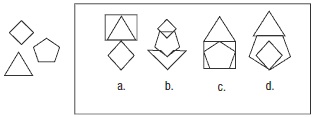
We determined earlier that the correct answer was in fact (c.). The question now emerges – just why the answer (c.) is and what strategy one can employ to solve problems such as this in a time effective manner?
The approach you should adopt involves the same process of elimination we described for the connection-type problem. In other words, you need to identify alterations in each shape to determine which answers are most certainly wrong. We will see this clearly as we go through this example. Some of you might be wondering, rightly perhaps, of how to interpret what this question is actually requesting us to do. This is a fair question. The purpose is to discover the shape that attaches each of the objects in the question in the most refined way. In other words, the question is asking us to figure out the following:
Which answer correctly possesses all shapes as stipulated by the question? – Which answer connects these shapes in a logically possible way? – Which answer retains the relative size of each of the shapes in question? Try to keep these questions in your mind as we go through this problem. We begin by looking at the question; which is composed of a triangle, rotated square, and pentagon. This analysis already tells us something important about the answer – it must contain each of these shapes, but it must also keep these shapes in their relative and precise sizes. In other words, if the triangle in the question happened to be three times the size it is now, we can expect the answer to similarly have a triangle three times its current size. This means we already have the knowledge to immediately dismiss any answer which does not contain just one of these shapes.

Always analyse the contents of the question. Ask yourself – are *all* of these individual shapes present in the same form in the answer? If not, disregard that answer and continue the process.
Through a simple examination of the answers, we find that Answer A violates this principle – in other words, Answer A does not contain a pentagon. Instead, Answer A contains a square, a rotated square (diamond shape), and a triangle. Therefore, we can dismiss Answer A. This now leaves us with three possible answers – Answer B, Answer C, and Answer D. How should we now proceed? The next step we should take is to analyse the overall shapes of the answer – in other words, do all shapes neatly fit into one coherent answer? The answer is no. Take a look at Answer B, where all the shapes are awkwardly overlapping – this is most certainly the most improbably way to sort these shapes into the simplest possible form. It’s for this reason we can dismiss Answer B as a possible answer.
This now leaves us with Answer C and Answer D. But, you have probably noticed Answer D suffers from the same problem. This answer assorts all the shapes, but the shapes are inconveniently located – particularly the presence of the square inside the pentagon, which should be flush with the corners. Contrast Answer D with the correct answer, Answer C, and you will notice how the correct answer is the one that neatly fits each of the three shapes into a logically possible form. Also notice how the shapes retain their structural and relative integrity in Answer C, but lose this property in Answer D. For these reasons, we can confidently arrive at Answer C for this ASVAB Assembling Objects problem.
Reviewing Puzzle-Type Problems
So, let’s review the steps you should take when it comes to solving the puzzle-type example of ASVAB Assembling Objects question:
- In the beginning, analyse the shapes involved in the question – as each shape must be present in the correct answer.
- Dismiss those answer(s) that do not contain at least one of these question shapes.
- At this point, notice how the shapes fit into each answer – is there a “better fit” for the shapes, relative to their sizes? Dismiss the answer that fits worst.
- Is there any answer that overlaps the shapes in an awkward or overlapping form? This should raise eyebrows as to whether it’s the best possible fit.
- Finally, discern between the remaining two answers which is the most logically relevant fit. Look at form, relative size, and continuity in this regard.
Following these steps will achieve two things – it will allow you to quickly analyse the question and answers, permitting you to arrive at the correct answer in a defined way and, second, it will provide you with a strategic approach to solving these problems – meaning you increase your probability of answering more questions correctly on the day of your exam. You will probably still have some degree of difficulty, but this will dissipate once you become used to the methods we have described, as practice is the key when it comes to working out these difficulties. One might know the method of how to cycle a bike – but it’s only through applying this method will we have any chance of success.
The final section of this ASVAB Assembling Objects study guide reviews what we have learned over the course of these resources.
Share
