


In this section, we will take you through a handy step-by-step guide of the two types of question you can expect to see on your exam – the connection-type question and the puzzle-type question.

Posted in 2nd December, 2014 | Assembling ObjectsHow to Assemble Objects

How to Assemble Objects


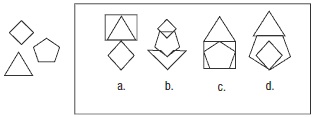
The type of question you can expect will be a typical one – where you are presented with some sketches and 4 possible answers. The object of each question is to link each sketch in the appropriate way. Some questions, as we will see below, require you to effectively “join the dots”, though many of the answer options are inverted to make the problem slightly more complex. Other problems require you to imagine what the sketches would look like if they were all inserted into one another – akin to placing items into a box and trying to concoct what the box would look like from above. This might sound frustrating, but with a little practice, you will possess the right skills to untangle these problems in an efficient way.
You will be asked either of the two classic kinds of question on your ASVAB Assembling Objects exam:
- Connection-type
- Puzzle-type
In each question, attempt the question yourself before proceeding to examine the detailed explanatory answer below. In addition, try to think of what process, or method, you are employing to determine the answer. If you can’t coordinate an effective strategy, this may be where you are going wrong in figuring out these questions.
Connection-Type Question 1
Puzzle-Type Question 2
Assembling Objects Problem Types
The correct answer for Example 1 is (d.), while the correct answer for Example 2 is (c.).
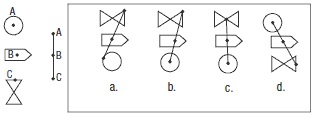
How did you do? Have you discovered a strategy for each type of problem yet? If not, let’s develop a coherent step-by-step strategy that allows you to solve each question in a logically defined, yet simple way. If we take a look at Example 1 above, we can first note the question on the left, with the four possible solutions on the right. In this type of ASVAB Assembling Objects question, we need to connect all three shapes using the connector located just to the right of the shapes. The first thing we should always note is where the dots are located in each shape – as these dots should be in precisely the same location in the correct answer.

This is a remarkably effective method to solve the problem, as it allows us to eliminate answers very quickly. Let’s take a look at Shape A in Example 1 – the circle with the dot located exactly in the center. We can expect, therefore, to find the dot in the center of the circle in the correct answer. Yet, when we glance at the answers, we find this is not the case. Which of the four possible answers is the only one that does not have the Shape A in the correct form? The answer, of course, is Answer A – where the dot for Shape A is located along the edge of the circle. We can, therefore, dismiss Answer A as it could not possibly be true.
This now leaves us with three possible answers – b., c., and d. If we now move to Shape B in the question for Example 1, we will find that its shape and the location of its dot are in exactly the right location in each possible answer – in other words, Shape B tells us nothing about determining the correct answer. We have to, at this point, turn to Shape C. This introduces a new problem you should be aware of – that shapes in the question are subject to rotation! Rotation is, it must be said, not the same as inversion. The best method one can employ in this regard is to think of a clock whose batteries are dead.

Always consider the rotational effects of assembling objects questions. An image may be rotated around its axis, but this is not the same as a mirror image or inversion.
If you set the clock hands to, say, 4 o’clock – this time will stay fixed as there are no batteries present in the clock. Now imagine tilting the clock around by 45 degrees, the hands of the clock will stay in the same location but all that has changed is the location of the clock. In the same way, the images can be rotated but the dot needs to maintain itself in the correct place. This is a crucial element to grasping how to effectively solve these types of ASVAB Assembling Objects problems. If we look at Shape C in the question, we can see the dot is located in the middle of the top line. Thus, imagine turning the shape 45 degrees, as you did with the clock, the dot should remain in the same place but only the shape of the object has changed direction – in other words, do not confuse shape rotation with dot location movement.If we take a look at Answer A and Answer B, we can find the dot on Shape C has suddenly changed. Originally, as we just saw, it was present in the middle of the top line, but now it’s present at a corner! No matter how much you rotate an object, if the dot remains in the middle it will always remain in the middle. Given the dot has shifted to the edge of one of the triangles, we can easily dismiss Answers A and B. If we glance at Answer C, we find the dot has, yet again, shifted to the center of Shape C – an impossible movement. This means, by deduction, the correct answer has to be Answer D. But, let’s take a look at three key factors at why specifically Answer D is correct:
- Crucially, all dots remain matched between their location in the question and their location in the answer.
- The shape of the objects themselves is the same in the question as they are in the answer.
- As per the question, the shapes (and the dots) are connected from Shape A to Shape B and, finally, to Shape C, in the right order (A – B – C).
- Even though one of the shapes has rotated, this does not render an answer false. The answer is produced by connecting the dots, irrespective of how the shapes of the objects are rotated.
This means we can confidently conclude that Answer D is indeed the correct answer. What’s more is not that we found the correct answer, but that we managed to produce a systematic strategy to determine the correct answer. In other words, we weren’t guessing – we devolved a coordinated strategy to figure out the problem. Constructing such a strategy is crucial as you have limited time available to answer all ASVAB Assembling Objects questions – and if you spend too much time on one question, this will act detrimentally on how you solve future questions with less time available. The connection-type questions are all based on this fundamental format, so mastering this technique is very much worth your while.
The next section looks at effective strategies you can adopt when attempting to answer puzzle-type assembling objects problems..
Share
